_edited_edited_p.png)
The Word No One Defines: Anthropogenic Know-How and Why Sites Get Missed

A site can be walked across and never recognized as one. A stand of culturally modified trees can be cleared before anyone reads what it was recording. A patch of vegetation holding the shape of an old field boundary can be mowed over and mistaken for nothing in particular. None of these losses announce themselves. They simply do not enter the record, and once that happens, the heritage they carried goes unprotected and the knowledge they held is gone before anyone thought to write it down. For close to two decades now, archaeologists have reached for the word anthropogenic to describe soil, stone, bone, and plants that seem to carry some trace of human activity, and it shows up constantly in site reports, compliance documents, and expert testimony alike. What it rarely gets is a definition anyone could apply consistently from one case to the next. Ask ten professionals working around cultural resources what makes something anthropogenic and you will likely get ten different answers, some pointing to an object humans clearly made or bred, others pointing to something that simply looks different near an old foundation, still others meaning something closer to disturbed or degraded. The word has been doing a great deal of subtle work in reports, filings, and site records without anyone agreeing on its job description. The cost of that inconsistency shows up as sites that go missed, heritage left unprotected because no one recognized it as heritage, and knowledge lost before anyone thought it worth recording.
This traces back to an older and shakier category: the ecofact. Archaeological sites are conventionally described as made up of artifacts, features, and ecofacts, and that third category has always been the least stable of the three (Sutton and Yohe 2003). The three categories lean on a set of oppositions that sound cleaner than they are: an artifact is mobile and directly modified, a feature is fixed in place but still directly modified, and an ecofact is supposed to be neither, unmodified and simply present. Some definitions limit ecofacts to unmodified organic remains. Others extend the label to any unmodified environmental material, organic or not. Both versions lean on the word unmodified, which turns out to be a strange foundation to build on (Morehart and Morell-Hart 2015). Domestication is itself a form of modification. A plant that grows differently because humans changed the soil beneath it is responding to modification, even if no one touched the plant itself. The line the category depends on was never as clean as it needed to be, and that gap is where anthropogenic crept in as a kind of conceptual patch, useful precisely because it was vague enough to cover whatever a given researcher needed it to cover (Schiffer 1987). A category vague enough to mean whatever a researcher needs it to mean is also vague enough to mean whatever a challenger needs it to mean, in a courtroom, a public comment period, or a due-diligence review. In CRM practice, without a working site definition, recognizing and documenting sites goes missed, and reviewers, clients, and colleagues within a firm are left to argue over what counts and what does not.

Binford's original definition of the ecofact only compounds the problem. He described it as culturally relevant nonartifactual data, broken into subclasses like pollen, soil, and animal bone, examples that all carry a buried connotation, evidence recovered from beneath the ground rather than standing on top of it (Binford 1964). That buried emphasis is part of why living, surface evidence keeps falling through the cracks of a category built to hold something else. Nicholas Kawa and colleagues tried to patch the gap directly, coining vivifacts for living organisms humans modified in the past that persist into the present, a culturally scarred tree still standing, and vivifeatures for landscapes that still carry the shape of past management, a clam garden still visible in the intertidal zone (Kawa et al. 2015). It is a useful repair, but it does not close the gap entirely. When Margesin and colleagues found soil microbiota in layers at Monte Iato in Sicily that had shifted composition in response to centuries of ritual feasting and fireplace use, they had evidence that was alive, in the sense that microbial communities are alive, and archaeologically significant, but caused indirectly rather than through the direct handling vivifacts was built to describe (Margesin et al. 2017). The category kept needing new patches because the underlying problem was never really about which materials counted. It was about how directly, and at what scale, something had to be touched by human activity before a report was willing to call it evidence at all.
One archaeologist did try to give the word itself a real definition. Gary Crawford described what he called anthropogenesis as the process by which human beings impact their environment, producing nonequilibrium ecological states marked by spatial and temporal patchiness, disturbance being the mechanism that pushes an ecosystem out of its prior balance (Crawford 1997). It is a genuinely useful definition, not least because it treats indirect human impact, removing trees and setting a cascade of ecological change in motion, as every bit as legitimate a form of anthropogenic evidence as a domesticate someone bred on purpose. But a definition that permissive raises its own hard question. Humans have touched nearly everything on earth in some roundabout way eventually, so if indirect impact counts, what stops anthropogenic from swallowing the whole landscape and losing its meaning entirely. Keeping the word useful takes two safeguards: a definition anchored in local, site-specific conditions, so a genuine human signature is not confused with a natural process capable of producing the same result on its own, and a willingness to recognize that anthropogenic evidence comes in more than one kind, direct and indirect, intentional and incidental, rather than forcing every trace of human presence into a single undifferentiated bucket. There is no single way for something to be anthropogenic, any more than there is a single way for something to be shaped by fire or water. It is more accurate, and more useful in practice, to think in terms of anthropogenisms, plural, than to keep reaching for one word and asking it to do every kind of work at once.
Not all evidence works the same way, and vegetation is as good a place as any to see the distinction clearly. Some plants carry their meaning with them wherever they are found. A tree bearing old bark scars from tool use, or a species that only exists because people cultivated it that way, tells you something about human activity no matter where you encounter it. Move it, and the story does not change. Other plants only become evidence because of where they happen to be standing. A native iris is, on its own, simply a native iris. Find that same iris blooming in a patch of dry, undisturbed ground beside a weathered headstone, in a spot no wild iris would naturally reach, and its presence starts to say something specific about who once tended that ground. Take it out of that setting and the story disappears with it. Knowing which kind of evidence is in front of you changes what a report can honestly claim, and what it can defend later if that claim is questioned.
This is not just a rhetorical device. British woodland ecologists formalized the same logic decades ago under the name ancient woodland indicator species, plants such as wood anemone, bluebell, and herb Paris that disperse so slowly and reproduce so conservatively that their presence in a given patch of trees is treated as reasonably strong evidence the woodland itself has stood, more or less continuously, for centuries (Rackham 2003). A single wood anemone tells a botanist almost nothing on its own. A cluster of these species recurring together across a stand of trees, especially concentrated along what turns out to be an old boundary bank or hedge line, becomes a working method for mapping where ancient woodland has and has not been cleared and replanted, long before any documentary record of the boundary survives. It is the same iris-beside-the-headstone logic, scaled up to the level of an entire management tradition, and it is the same logic a National Register nomination or a cultural landscape study leans on when it argues that a stand of trees is not incidental to a property's significance but part of the evidence for it.
Linguists have a name for this general distinction, the difference between a sign that means something on its own and a sign that only means something because of what it is standing next to (Preucel 2006; Cipolla and Harris 2017), but the label matters less than the habit of mind it encourages. Some evidence speaks for itself. Some evidence only speaks in relation to its surroundings, and knowing which kind you are looking at changes what you owe it in the way of documentation. The same distinction holds up almost unchanged once you leave vegetation behind and start asking the same question of stone, bone, and soil, three categories of evidence that show up constantly in compliance reports, expert testimony, and site assessments, each with its own version of the same problem.

Is It Just a Rock?
Stone raises the same question first. Spend enough time walking a survey transect and you start to understand why archaeologists have a separate word for a rock that looks like a tool but isn't one. They call it a geofact, a naturally fractured stone that mimics the traits of deliberate flaking closely enough to fool an inattentive eye (Barnes 1939). Fire will do this. A prescribed burn or a wildfire heats local chert and other fine-grained stone, turning it orange or ruddy pink in the same way deliberate heat-treatment does, and the rock then exfoliates over time into smaller pieces with smooth, scalloped, almost moon-cratered surfaces. Cattle and heavy equipment do it too, crushing thin edges of shattered rock in ways that can look, at a glance, like careful pressure flaking. Tillage leaves its own signature, small v-shaped nicks scattered at random along a piece of shatter.
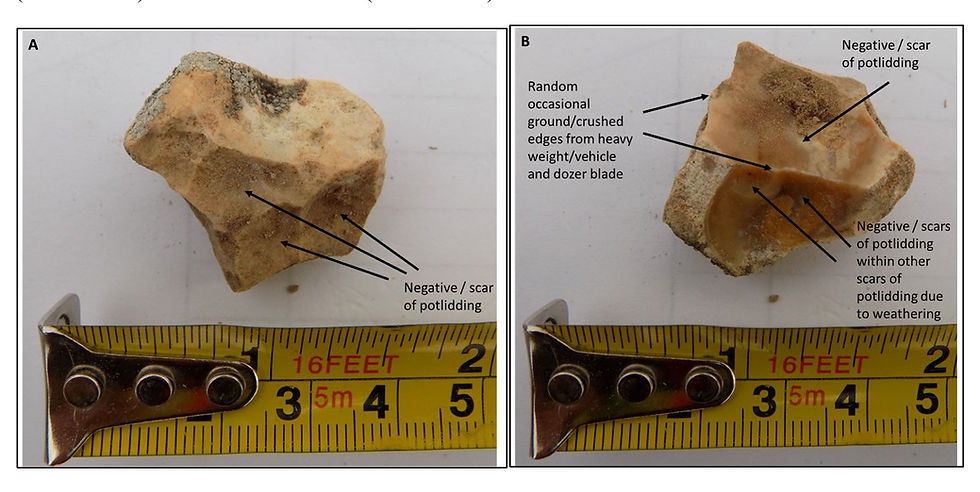
The traits that separate a genuine artifact from all of this speak for themselves once you know to look. A true flake carries a bulb of percussion, a platform, redundant edge angles that fall in a predictable range, and evidence of deliberate, repeated flake removal along one or both edges rather than random, isolated damage (Andrefsky 2005). None of that requires its surroundings to interpret. A bulb of percussion means a controlled blow was struck, wherever the stone happens to be lying. What separates the natural look-alikes is precisely their randomness: cattle and machinery leave scuff marks distributed without pattern, fire-spalled rock exfoliates with no point of initiation and no true striking platform, and tillage nicks show up wherever a plow happened to catch an edge rather than in the redundant, controlled sequence a person flaking stone on purpose would leave behind. The tell is not any single mark. It is whether the marks repeat in a way chance would not produce.
The stakes of getting this distinction wrong are not hypothetical. The Calico Early Man site in California's Mojave Desert became the center of a decades-long dispute after excavators, working with the paleoanthropologist Louis Leakey, argued that flaked stone recovered from ancient lakebed sediments represented tool-making activity roughly 200,000 years old, a date that would upend the accepted timeline for when humans first arrived in the Americas. Most archaeologists who have examined the collection since have concluded instead that the pieces are geofacts, produced by natural fracturing within the old lake gravels rather than deliberate human flaking, and the debate has never fully closed (Haynes 1973). Read one way, a flake tells a story about the deep human past. Read the other way, it tells a story about geology, and very little else. For a developer weighing whether a find requires a change in plans, or a reviewer deciding whether a determination will hold up to outside scrutiny, that is not a small difference. It is the difference between a defensible finding and an expensive mistake.
Then there is the manuport, a stone that was never modified at all and still counts as evidence, for reasons that have nothing to do with its shape. A manuport is simply a rock that does not belong where it was found, transported by human hands into a setting its own geology could never explain. Unlike a flake's bulb of percussion, a manuport's evidentiary weight is entirely extrinsic. Pull it out of its setting and hand it to someone cold, and it is just a rock. Leave it where a careful survey found it, well outside the range of any natural source for that stone type, and it becomes a small, specific fact about how far, and by what means, something once traveled.
Is It Just a Bone?
Bone raises the question a second time, and the physical vocabulary is, if anything, even more precise. A cut mark left by a stone tool edge is V-shaped in cross-section, carrying fine parallel striations where the edge dragged across the bone surface, and it appears at consistent anatomical locations, joints, tendon attachments, the places a person disarticulating or defleshing an animal would need to cut (Binford 1981; Lyman 1994). A carnivore's tooth leaves something rounder, a U-shaped pit, puncture, or score, clustered at the fat-rich, marrow-rich ends of a bone rather than along a joint line. A rodent's gnawing leaves parallel, flat-bottomed grooves in close, paired sets, the trace of a pair of incisors working an edge. None of these three marks needs its surroundings to be read. A trained eye can identify a cut mark on a single bone fragment with no other context at all, which puts it squarely in the same category as a bulb of percussion or a scarred tree trunk, evidence that speaks for itself.
The history of zooarchaeology holds an instructive cautionary tale on exactly this point. In the 1950s, the anatomist Raymond Dart proposed that early hominins at the South African cave site of Makapansgat had developed what he called an osteodontokeratic culture, a toolkit built from broken and selectively modified bone, tooth, and horn, based largely on the same kind of skewed skeletal part representation discussed below (Dart 1957). Later taphonomic research by C. K. Brain demonstrated that most of the damage and accumulation patterns Dart had attributed to hominin toolmaking were instead the ordinary signature of leopards and hyenas processing carcasses, with the apparent blackening of the bone caused by manganese staining rather than fire (Brain 1981). The episode did real damage to one specific hypothesis, but it forced the field to develop the controlled, comparative taphonomic methods that make it possible today to tell a cut mark from a tooth mark with confidence. That confidence matters well beyond a South African cave. Claims involving human or faunal remains, whether in a repatriation case, a burial disturbance finding, or a contested excavation report, rise or fall on this kind of evidentiary discipline.
Fracture patterns tell a related but distinct story. Bone broken while still fresh, while its collagen retains some elasticity, breaks in a curving, spiral pattern, often with a clear point of impact and small negative flake scars that would look entirely at home in a lithics report (Villa and Mahieu 1991). Bone broken long after death, once that collagen has degraded, fractures instead along jagged, roughly right-angled lines dictated by the bone's own internal structure rather than the force applied to it. A spiral fracture is strong evidence that a bone was broken at or near the time of death, commonly for marrow extraction, but it is not absolute proof of human action on its own, since large animals trampling a fresh carcass can occasionally produce something similar. Burning adds a further layer: bone exposed to brief, lower-intensity heat chars black, while bone exposed to sustained, direct fire calcines to a brittle white or blue-gray. A natural fire tends to leave burning scattered unevenly across an assemblage. Deliberate cooking leaves a more localized, patterned scorch tied to how a particular bone sat relative to a hearth.
The relational category has its own bone equivalent, and it works exactly like the vegetation co-occurrence pattern discussed earlier. No single bone in an assemblage needs a single cut mark for the assemblage as a whole to carry a human signature. If a collection of animal remains is dominated by high-utility limb bones, over-represented relative to what a natural death at that spot would produce, that skewed ratio is itself evidence of selective transport, of someone carrying the better cuts back to camp and leaving the rest behind. The pattern only becomes visible once you stop looking at individual bones and start looking at the whole assemblage in relation to what an untouched, naturally accumulated one would look like.
Is It Just Typical Soil?
Soil raises the question a third time, and pushes hardest against the line between the two categories, because it is the least visually dramatic of the three and in some ways the most interesting. A soil chemist can measure phosphate levels in a sample and find them elevated well above the local background, a signature left by concentrated organic waste, ash, and bone breaking down over time (Holliday and Gartner 2007). That elevated reading is, in one sense, intrinsic. Wherever you find that chemistry, it means enrichment happened. But you cannot read it without a baseline to compare it against, without knowing what the surrounding, undisturbed soil looks like first. The signal only becomes legible in relation to its setting, which places it somewhere between the two categories this whole framework otherwise keeps separate.
The clearest large-scale illustration of soil carrying this kind of dual evidentiary weight comes from the Amazon basin, where pre-Columbian communities created what is now known as terra preta, dark, exceptionally fertile soil built up over centuries through the deliberate incorporation of charcoal, bone, pottery fragments, and other domestic refuse into otherwise nutrient-poor tropical ground (Woods et al. 2009). A single dark patch of soil in the Amazon means little on its own. Hundreds of these patches, radiocarbon dated, mapped against river corridors, and found together with pottery and charcoal, add up to some of the strongest evidence available anywhere for the scale and permanence of pre-Columbian Amazonian settlement, a scale many earlier archaeologists badly underestimated because they were not reading the soil itself as evidence. The same logic applies at a much smaller scale on almost any project site. A single soil color change or phosphate reading rarely settles a question on its own, but it can be the first thread that either supports or unravels a larger determination, which is why it deserves to be read carefully rather than noted in passing.

The more visible traces sit more comfortably on the intrinsic side. Charcoal flecking and ash lenses in a soil profile are a fairly direct record of fire, wherever they turn up. Soil science has a formal name for ground genuinely transformed by long-term habitation, an anthropic epipedon, a dark, organically and chemically enriched surface horizon that forms under sustained human occupation in a way ordinary pedogenic processes do not reproduce on their own (Soil Survey Staff 2014). Disrupted stratigraphy carries a similar directness. Undisturbed ground layers sit in a predictable sequence, governed by weathering and deposition working over time in one direction. A backfilled pit, a grave shaft, a construction trench shows the opposite, a jumbled, out-of-sequence mixing of layers that does not occur without someone having dug the ground open and put it back. Munsell color darkening, by contrast, tips back toward the extrinsic side of the ledger, since a dark soil only means something once it is compared against the lighter matrix around it. None of these signals alone closes the case the way a bulb of percussion or a genuine cut mark can. Read together, the way careful excavation is supposed to read them, they turn a patch of ground that looks like nothing in particular into a legible record of what happened there.
A Habit of Mind
None of this stays theoretical for long, and the stakes are not limited to any one kind of evidence. In French Polynesia, stands of candlenut and bamboo mark centuries of deliberate cultivation so precisely that researchers can trace old land use patterns through the forest's species composition alone (Larrue et al. 2010). In northern Scandinavia, researchers identified centuries old Saami reindeer pens from satellite imagery, not because the pens themselves were visible, but because the shape and makeup of the vegetation growing over them still held the pattern (Tommervik et al. 2010). A flake's bulb of percussion, a bone's cut mark, a soil profile's disrupted layering, and a lilac blooming beside an unmarked grave are all, in their own way, doing the same work an artifact does, carrying forward a record of what people once did in a place. The difference across all of them is simply whether that record announces itself on its own, or only once you know enough about its surroundings to ask the right question of it. None of them are anthropogenic in quite the same way, and that is the point. Treating anthropogenic as a single, uniform category, rather than a family of related but distinct processes, is exactly what let the word go undefined for so long in the first place.

This distinction is not confined to archaeology. A restitution claim built on evidence that only speaks in context, provenance inferred rather than documented, is a weaker claim than one resting on evidence that speaks for itself, and knowing which kind of evidence is on the table changes how a case gets built and argued. A compliance determination that treats every trace of past land use as equally strong evidence, rather than distinguishing what a site tells you outright from what it only tells you once compared against its surroundings, is vulnerable to challenge, whether from a developer, a public commenter, or a reviewing agency. A project that cannot tell a genuine cultural feature from something that only resembles one is exposed to exactly the kind of costly, late-stage delay this framework is built to prevent. The habit of mind described here was shaped for reading a landscape, but it holds up anywhere a decision depends on how much weight a piece of evidence can bear, in a courtroom, in a policy review, or on a construction schedule.
It takes one habit of mind, applied consistently across whatever kind of evidence is in front of you: does this fact speak for itself, or does it only speak in relation to what surrounds it. That single question, asked of plants and stone and bone and soil alike, does more to recover the human story written into a landscape, and to make sure the record built on it holds up, than any amount of vague, well meaning language about the surrounding vegetation, or debris, or dirt, ever has.
Here is what that distinction looks like in practice, for anyone who has to act on a piece of evidence rather than admire it. Whether the evidence speaks for itself is worth asking first. A cut mark, a bulb of percussion, a culturally scarred tree, an anthropic soil horizon, these carry their meaning with them regardless of what surrounds them, and a report that documents them well can stand on that documentation alone. If a determination rests on this kind of evidence, the question worth putting to an expert, or to your own team, is narrow: is the physical signature documented clearly enough that a second reviewer, with no other context, would reach the same conclusion.
For anything that only speaks in context, the question is whether the baseline has actually been established. An introduced species, a manuport, a Munsell color shift, a skewed ratio of skeletal parts, none of these mean anything without a documented comparison, whether that is the surrounding undisturbed soil, the known natural range of a species, or the composition an untouched assemblage would show. A report that names this kind of evidence without showing the comparison it depends on has not made its case yet, no matter how confident the language sounds.
Then there is the term doing the load-bearing work in a report or a filing, anthropogenic, human-modified, disturbed, degraded. It either holds to a stated definition, or it is functioning the way this piece opened by describing, a stand-in for whatever the writer needed it to mean at that moment. A term this central to a determination that cannot be pinned to a specific, repeatable standard is worth flagging before the determination is relied on, not after it is challenged.
None of this will settle every disputed site, but it draws a clear enough line between evidence that will hold up under scrutiny and evidence that only sounds like it will, and that line is worth knowing before a claim, a determination, or a project timeline is built on top of it. I already have my own thoughts on where that line falls in practice, and I will share them soon.
Keep an eye out for more articles on the subject of anthropogenic vegetation. I'll share about particular instances and approaches to recognizing anthropogenic vegetation, and those with regional and site-specific characteristics.

Which of these historic features vegetation would you have recognized as anthropogenic?
Yes, both would have caught my eye.
Only the left one (thin, stunted patch over the corral)
Only the right one (the lush, overgrown patch over the privy
Honestly, neither, they'd just look like grass to me.
Sources
Andrefsky, William Jr.
2005 Lithics: Macroscopic Approaches to Analysis, 2nd ed. Cambridge University Press, Cambridge, UK.
Barnes, Alfred S.
1939 The differences between natural and human flaking on prehistoric flint implements. American Anthropologist 41(1):99–112.
Binford, Lewis R.
1964 A Consideration of Archaeological Research Design. American Antiquity 29(4):425–441.
Binford, Lewis R.
1981 Bones: Ancient Men and Modern Myths. Academic Press, New York, NY.
Brain, C. K.
1981 The Hunters or the Hunted? An Introduction to African Cave Taphonomy. University of Chicago Press, Chicago, IL.
Cipolla, Craig N., and Oliver J. T. Harris
2017 Archaeological Theory in the New Millennium: Introducing Current Perspectives. Routledge, New York, NY.
Crawford, Gary W.
1997 Anthropogenesis in Prehistoric Northeastern Japan. In People, Plants, and Landscapes: Studies in Paleoethnobotany, edited by Kristen J. Gremillion, pp. 86–103. University of Alabama Press, Tuscaloosa, AL.
Dart, Raymond A.
1957 The Osteodontokeratic Culture of Australopithecus prometheus. Transvaal Museum Memoir No. 10, Pretoria, South Africa.
Harris, John S.
2018 The Sylvan Blindspot: The Archaeological Value of Surface Vegetation and a Critique of its Documentation. Unpublished Master's thesis, Department of Anthropology, University of Montana, Missoula. Electronic document, https://scholarworks.umt.edu/etd/11214
Haynes, C. Vance
1973 The Calico site: Artifacts or geofacts? Science 181(4097):305–310.
Holliday, Vance T., and William G. Gartner
2007 Methods of soil P analysis in archaeology. Journal of Archaeological Science 34(2):301–333.
Kawa, Nicholas C., Bradley Painter, and Cailín E. Murray
2015 Trail Trees: Living Artifacts (Vivifacts) of Eastern North America. Ethnobiology Letters 6(1):183–188.
Larrue, Sebastien, Jean-Yves Meyer, and Thomas Chiron
2010 Anthropogenic vegetation contributions to Polynesia's social heritage: The legacy of candlenut tree (Aleurites moluccana) forests and bamboo (Schizostachyum glaucifolium) groves on the island of Tahiti. Economic Botany 64(4):329–339.
Lyman, R. Lee
1994 Vertebrate Taphonomy. Cambridge University Press, Cambridge, UK.
Margesin, Rosa, José A. Siles, Tomas Cajthaml, Birgit Öhlinger, and Erich Kistler
2017 Microbiology Meets Archaeology: Soil Microbial Communities Reveal Different Human Activities at Archaic Monte Iato (Sixth Century BC). Microbial Ecology 73(4):925–938.
Morehart, Christopher T., and Shanti Morell-Hart
2015 Beyond the ecofact: Toward a social paleoethnobotany in Mesoamerica. Journal of Archaeological Method and Theory 22(2):483–511.
Preucel, Robert W.
2006 Archaeological Semiotics. Blackwell Publishing, Malden, MA.
Rackham, Oliver
2003 Ancient Woodland: Its History, Vegetation and Uses in England. Castlepoint Press, Colvend, UK.
Schiffer, Michael B.
1987 Formation Processes of the Archaeological Record. University of Utah Press, Salt Lake City, UT.
Soil Survey Staff
2014 Keys to Soil Taxonomy, 12th ed. USDA Natural Resources Conservation Service, Washington, DC.
Sutton, Mark Q., and Robert M. Yohe II
2003 Archaeology: The Science of the Human Past. Pearson Education, Boston, MA.
Tommervik, Hans, Sigbjorn Dunfjeld, Gunilla A. Olsson, and Marit N. Ostby
2010 Detection of ancient reindeer pens, cultural remains and anthropogenic influenced vegetation in Byrkije (Borgefjell) Mountains, Fennoscandia. Landscape and Urban Planning 98:56–71.
Villa, Paola, and Eric Mahieu
1991 Breakage patterns of human long bones. Journal of Human Evolution 21(1):27–48.
Woods, William I., Wenceslau G. Teixeira, Johannes Lehmann, Christoph Steiner, Antoinette WinklerPrins, and Lilian Rebellato (eds.)
2009 Amazonian Dark Earths: Wim Sombroek's Vision. Springer, Dordrecht, Netherlands.


Comments